Laura Waddington
Opening 6 December 2026: Ageless, Ageless: Border
In the third exhibition of Ageless, Ageless, we present Laura Waddington’s 2004 film Border.
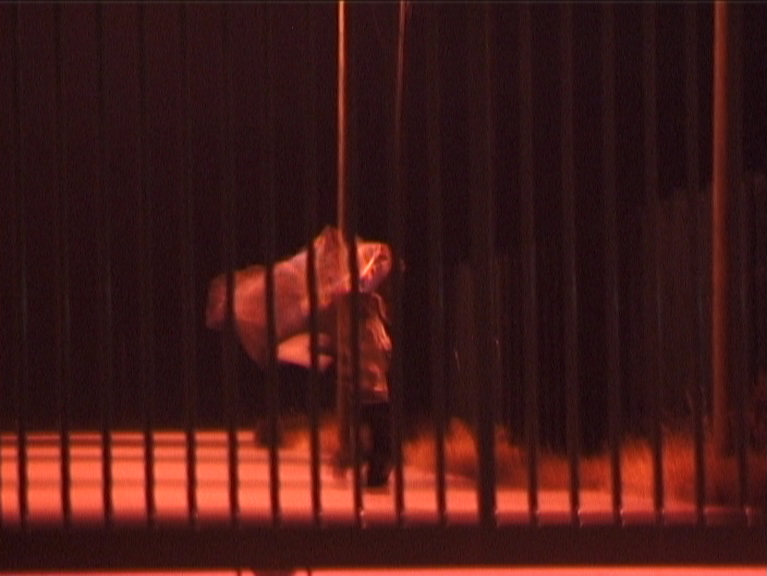
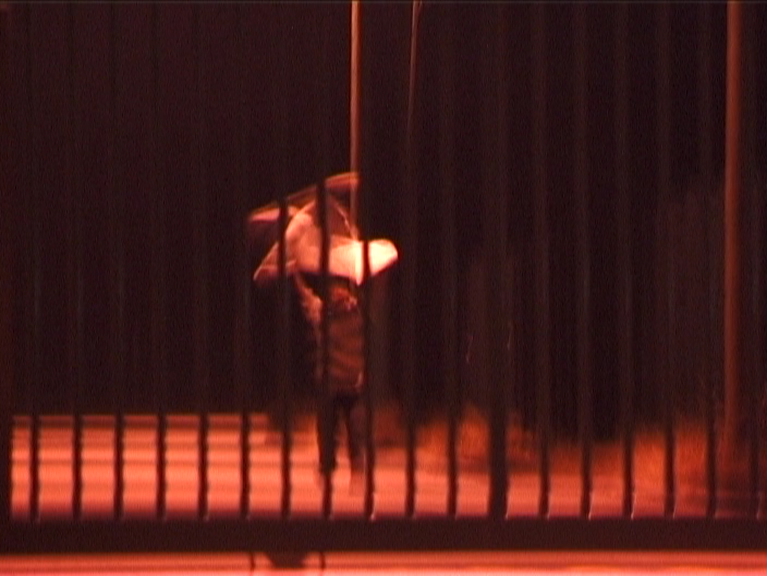
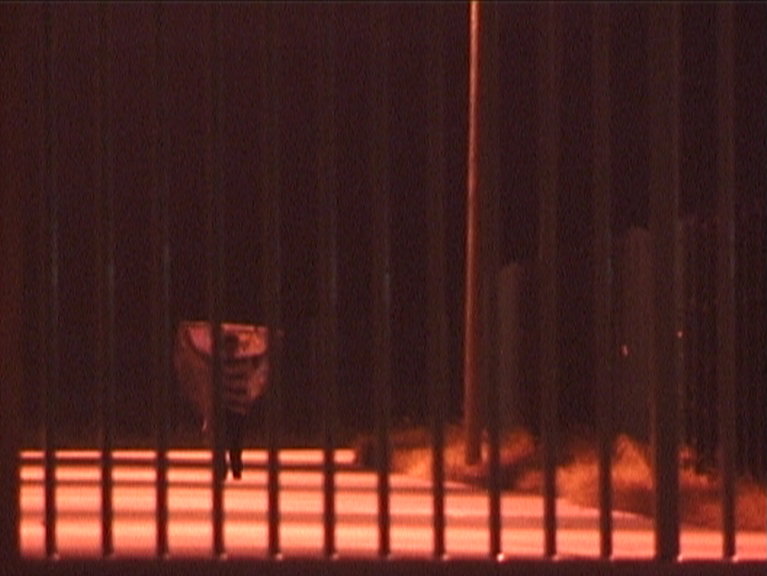
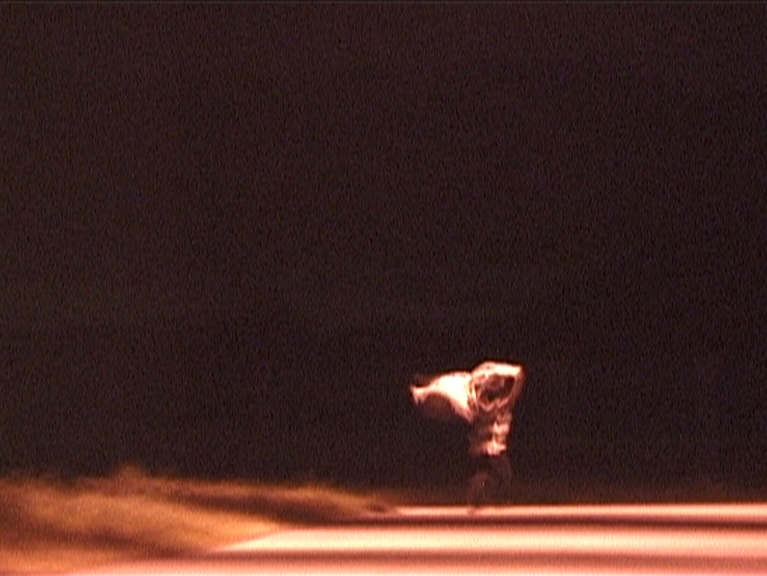
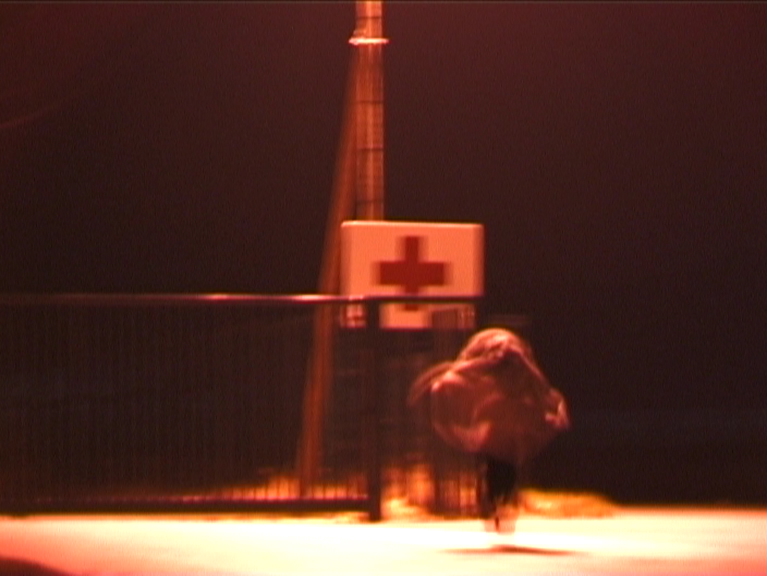
In 2002, Laura Waddington spent several months in the fields around Sangatte Red Cross camp, France with Afghan and Iraqi refugees, who were trying to cross the channel tunnel to England. Filmed at night with a small video camera, the figures lit only by the distant car headlights on the motorways, Border is a personal account of the refugees’ plight and the police violence that followed the camp’s closure.
What stays with us from Waddington’s film is how little the ‘content’ of our screens has changed over the years. What we saw then, we see now: running, hiding, escaping, suffering, dying, surviving, and hoping. As Waddington writes about the work: “I couldn’t believe we had just left them there, as if our backs were turned to them”.
In Border, a child moves with a blanket in the air, sometimes wrapped and other times fluttering around his body, while orange industrial lights seem to obscure as much as reveal his movements. At moments, the blanket turns into a cape, a wing, something to take flight; at others, it catches in the wind above his head, frames fragmenting as the camera searches for the light that will give shape to these gestures.
The blanket brings us to the fold—le pli in French, connected through plier to the Latin plicare, meaning “to fold”. This Latin root appears in words such as complicate, explicate, and finally implicate. To be implicated is to be involved: to ask how we, as viewers, are bound in what we see. From here, the question becomes one of agency: among us, who is allowed to act, whose room to move is expansive, and whose is narrow?
These fleeting gestures, appearing and disappearing in the dark, bring us back to Georges Didi-Huberman’s (2009) Survivance des lucioles [Survival of the Fireflies], the book through which we first encountered Waddington’s work. The book offers a plea to hold onto the hope that fireflies present us in the image plane and further afield in the darkness. No matter how dark a night can be, it can still be traversed by fleeting illuminations, by fragile forms of life that persist despite everything. As Didi-Huberman writes, “Have the fireflies disappeared? Of course not. Some of them are near us. They brush past us in the dark.” Hope is the illumination of that which flashes out from the dark, against the haziness of pessimism. To quote Paul Gilroy, another pillar in our recent thinking and work: “I don’t think we can afford the luxury of pessimism”.
ABOUT THE ARTIST:
Laura Waddington makes films, books and other projects, with a particular focus on issues of migration and statelessness and experimentations with form. Her films and videos have been shown widely at international film festivals including Locarno, Rotterdam, the New York Video Festival at the Film Society of Lincoln Center, Montreal (FCMM), and London, and in museums such as the Reina Sofia Museum, Madrid, the Jeu de Paume, Paris, the Walker Art Center, Minneapolis and the Wifredo Lam Contemporary Art Center, Havana. Focuses and spotlights on her work have been held at the Oberhausen International Short Film Festival, the Pesaro International Film Festival, the Pompidou Center, Paris and the Austrian Film Museum, Vienna. She is the recipient of several awards, including the ARTE Prize for Best European Short Film. She has spoken in venues such as the European Parliament, publishes articles on film and art internationally and has lived around the world.
ABOUT BORDER:
In the days, if you wandered along the motorways and the wastelands, you could see the refugees everywhere: waiting on the roadside or headed to the port and the freight trains. They travelled in twos or threes or sometimes in groups of twenty or thirty.
At night, I’d walk along the roads with them. It took two or three hours to reach the spots on the channel tunnel fence, where they’d start to cut the wire. Then came the arrests and the police bus back to the camp. A few hours later, they’d re-emerge and the perverse game of cat and mouse would start again.
Most of the refugees were from Iraq and Afghanistan. They’d taken six or seven months to get to France, paying traffickers to smuggle them in trucks across Iran, Turkey and the Balkans. Many had nothing left but the clothes they were standing in. In their countries, they’d been teachers, university professors, medical students, and bricklayers.
Some men died in the tunnel, others had their arms or legs cut off by the moving trains. I remember, one boy who lost his leg was out on the road, the week he was released from the hospital, trying to escape again. The months passed in limbo. I couldn’t believe we had just left them there, as if our backs were turned to them. Laura Waddington 2002
ABOUT AGELESS, AGELESS,
Through his study of images, the historian Aby Warburg (1866–1929) coined the term Pathosformel, which he defined as ‘charged visual figures’: specific gestures, postures, or expressions that recur across time. Warburg studied how these visual figures return to us as concentrated signals of suffering, fear, or ecstasy: motifs that operate as sites where cultural memory stores and releases its accumulated force.
Shimmer’s multi-year study Ageless, Ageless, is centred on these signals: shared cultural forms such as the lullaby’s pulse, call-and-response, the ritual of the threshold, or the cadence of mourning. Travelling across geographies, languages, politics, and belief, these hazy forms ‘flash’ up to the surface, letting us observe what repeats and what changes. By holding these patterns momentarily in view, slowly and together—with you, our audience—we intend to make a space where differences can meet without hardening.
‘Ageless, Ageless’ is a repeated lyric from Mojo Pin (1994) by Jeff Buckley (1966–1997), an artist who was inspired by devotional music, and in particular by the work of the Sufi singer Nusrat Fateh Ali Khan (1948–1997), like Khan and Buckley, this program connects with repetition, where meaning melts away to connect us back to the deep. For us, agelessness is distinct from timelessness: it folds the past into the present in order to imagine the future anew.
Ageless, Ageless proposes artworks, exhibitions, writings, and collective studies that treat memory and presence as forms of continuity: not to rhyme with or repeat the past, but to remain continually informed by it.
REFERENCES
Didi-Huberman, G. (2009). Survivance des lucioles [Survival of the fireflies]. Les Éditions de Minuit.
Ministère de l’Éducation nationale et de la Jeunesse. (2018, November). Lexique et culture : Simple. Éduscol.
O’Hagan, S. (2020, November 15). Paul Gilroy: ‘I don’t think we can afford the luxury of pessimism’. The Observer.
Smith, A. (2021). Georges Didi-Huberman and film: The politics of the image. Bloomsbury Academic.