Sunday Afternoon with Lisa Robertson
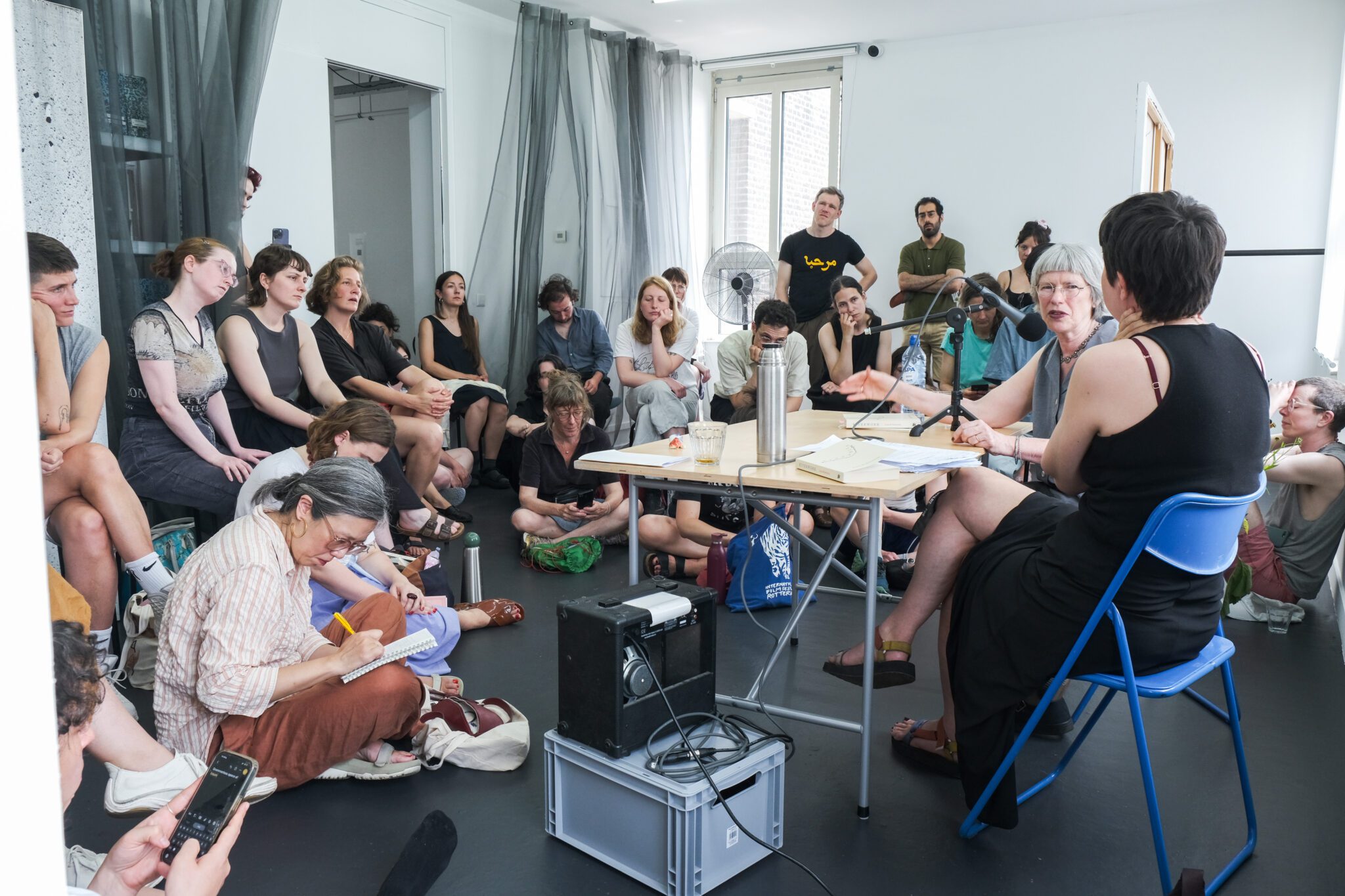
In Conversation with Kate Briggs|
On the occasion of Ageless, Ageless andthe launch of Riverwork
Sunday 21 June, 2pm
To attend, kindly send your RSVP to shimmerrotterdam@gmail.com
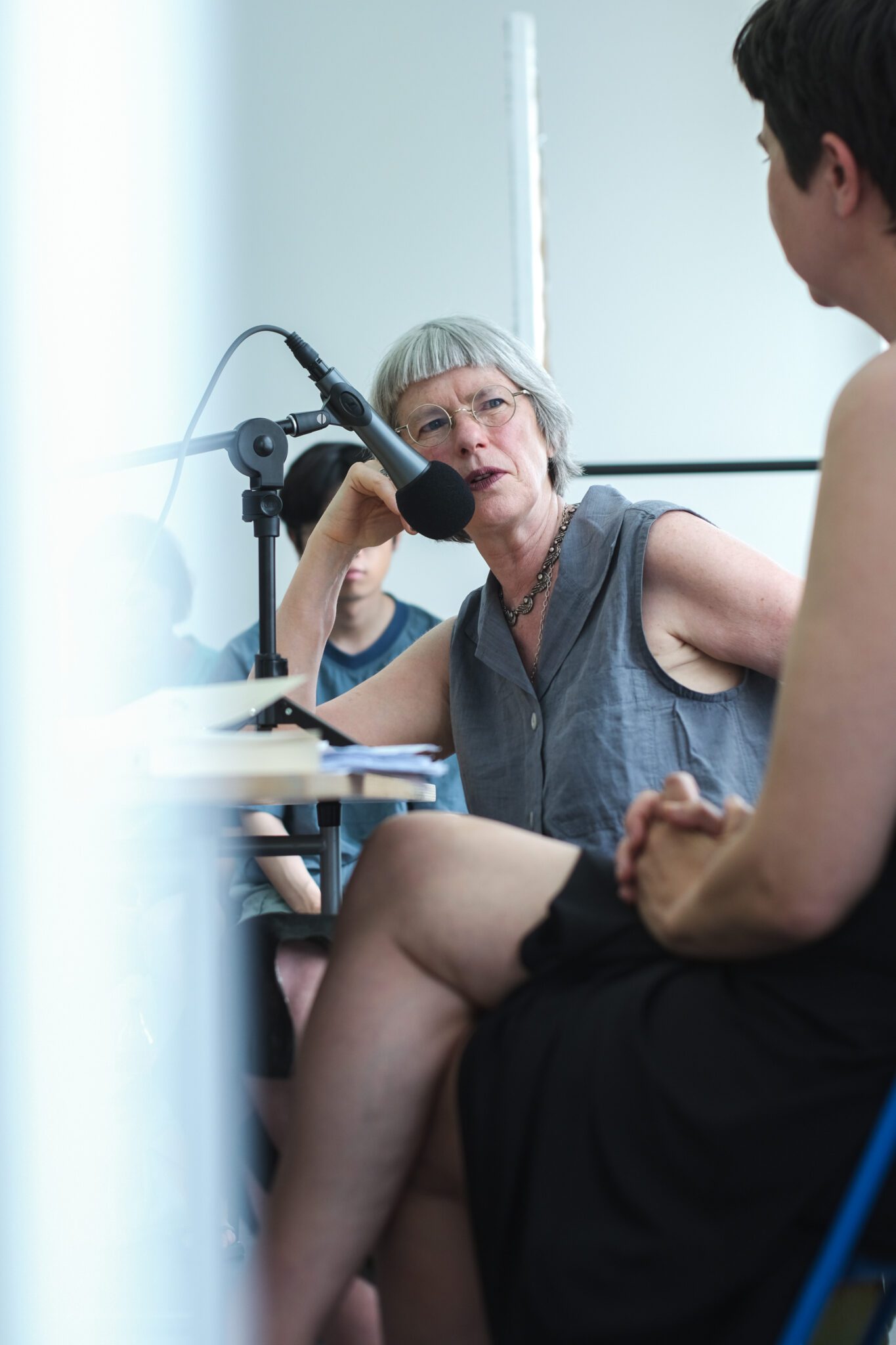
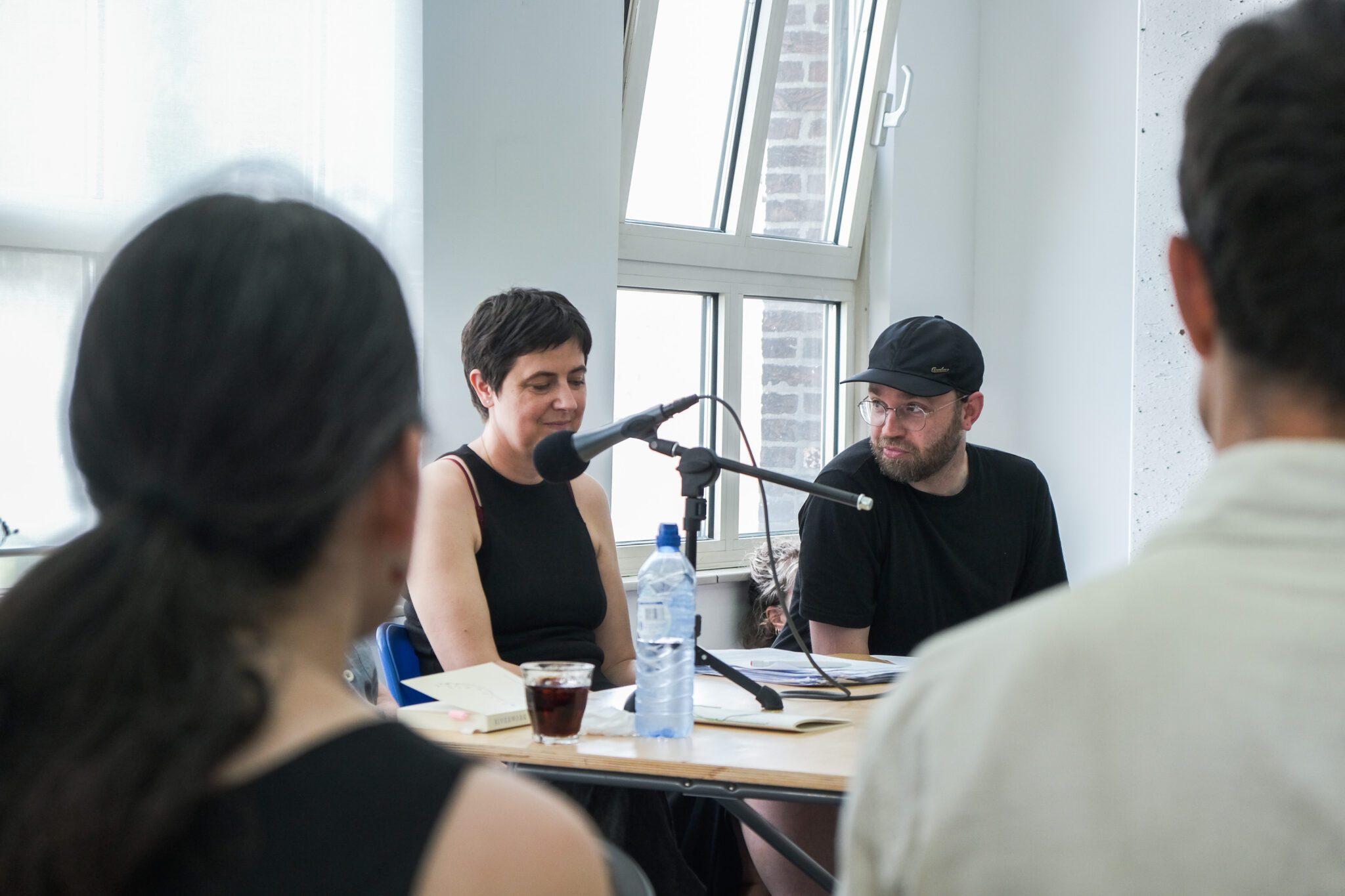
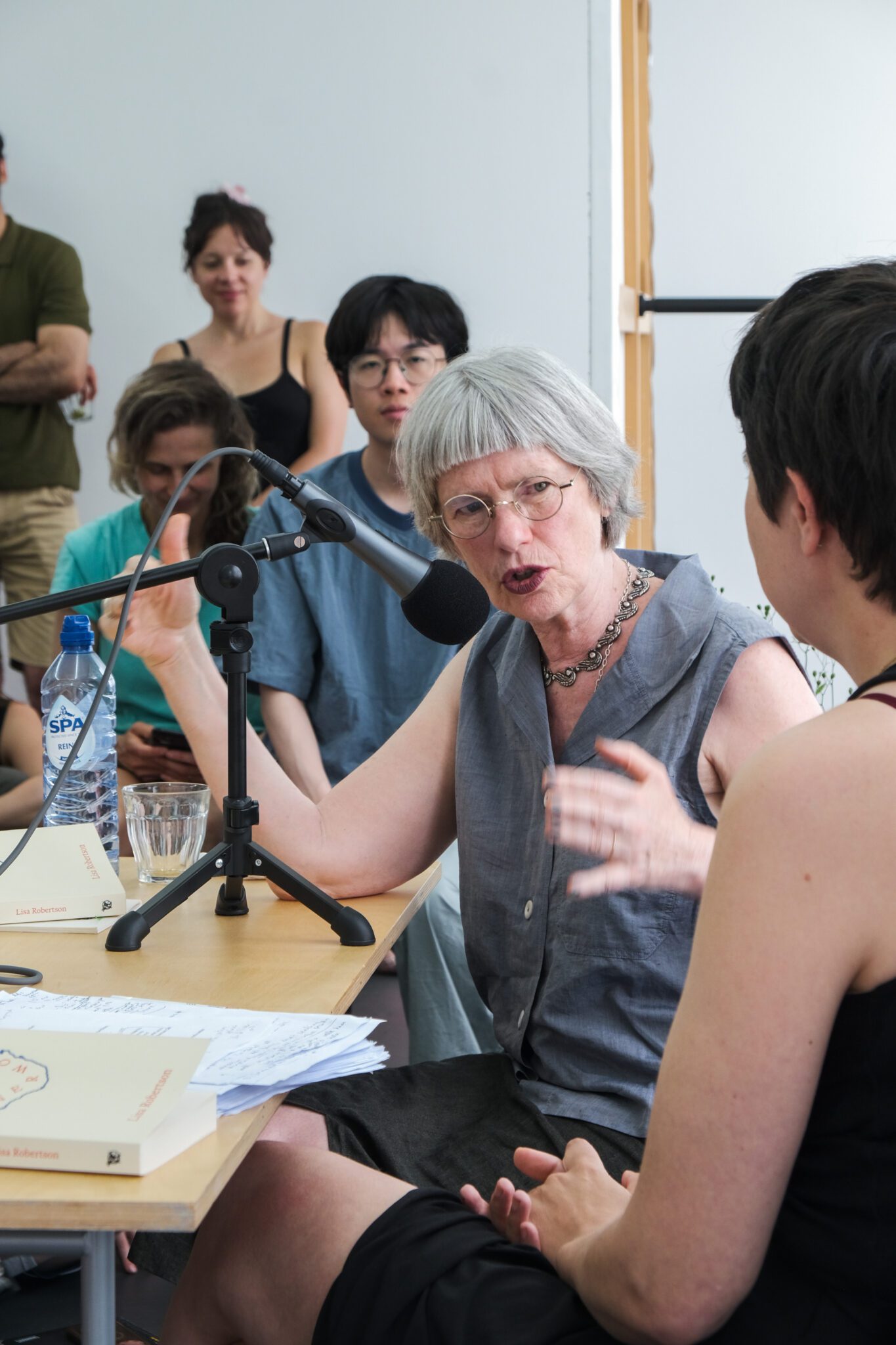
Kindly join us for Sunday Afternoon with Lisa Robertson on 21 June at 2 pm. On this day, Lisa will read from her new book, Riverwork (Coach House Books, 2026), and enter into conversation with author and translator Kate Briggs. To attend, kindly RSVP by emailing shimmerrotterdam@gmail.com
In 2013, a student asked Lisa Robertson how she knew that the words she wrote were the right ones. “It is how they feel in the mouth,” is how I remember Lisa’s reply. Since then, when I think about words, I feel their spacing against my cheek and tongue. The feeling of language, its materiality, is what I have learned from Lisa. I have also learned about phenomenology, astronomy, the weather, the softness of architecture, Levinas, and fashion from her.
And now, in Lisa’s new book Riverwork, I learn about a river, one that is no longer present except through the labour of those who lived along it. I think of that waterway while sitting beside the Maas River, at Shimmer, as traces of the port’s pollution float through the windows left open by Cally Spooner. I see the residue of life settling on the surface of Thomas Fougeirol’s paintings and in between the wooden pieces of Fernanda Gomes’ sculpture. Ageless, Ageless, Shimmer’s current exhibition inspired by Aby Warburg and Walter Benjamin, is also an exhibition inspired by Lisa’s poetry and teaching. As such, it is incredible special to invite you to Sunday Afternoon with Lisa Robertson in conversation with Kate Briggs. Kindly reply to this email to secure your seat.
Lisa writes:
Yet one prefers a silk of pronounced, weighted rustling. One is compelled toward crystalline manifestations. Silk ties and ribbons shatter at the knot points; silk gowns shatter in the folds that have touched the body, absorbing the salts and scent of perspiration: inner elbow, waist, underarm, collar facing. What was heavy and opaque becomes translucent. The warp is revealed. Ribbons disintegrate when handled. They are filmic. (Riverwork, p. 104)
I feel silk against my tongue and teeth, looking at the world reflected on Pam Virada’s bubbles: disintegrating and filmic made of river water. Now gone.
ABOUT RIVERWORK
Some ruins are invisible.
Under the pavements of Paris lies an ancient, buried river: the Bièvre. For years, Lucy Frost has walked along these streets, unaware of the water and history beneath her feet, on her way to clean the apartments of Paris’s academic class. As she begins to study and transcribe the inherited notebooks and papers of her great-aunt, a teacher and researcher who disappeared years earlier, she commits to continuing her aunt’s youthful research on the Bièvre, mining the river’s documentary traces in the works of Rousseau, Rabelais, Hugo, Chateaubriand, and others. She uncovers a history of industry: paper mills, dyeing workshops, tanneries, textile manufacturers, and laundries.
She finds resonances of her own labour in the history of the river’s laundresses. In stolen time at work, and during her insomniac hours of night writing, she fills notebooks with these woven stories and descriptions of obsolete sites, textiles, cosmologies, and voices, constructing her own forms of relation with the lost.
Riverwork unearths not only an urban river but also a philosophy of research and the archive, a politics of hydrology, an ontology of ageing and belatedness, and a consideration of the unrepresented labour of women, past and present. Along the way, it brings to life, in pyrotechnic prose, a long-gone Paris and both its domestic workers and its writers.
LISA ROBERTSON is a Canadian poet, essayist, and novelist who lives in France. Born in Toronto in 1961, she was a long-time resident of Vancouver. She has published nine books of poetry, most recently Boat (2022), and two books of essays, Nilling (2012) and Occasional Work and Seven Walks from the Office for Soft Architecture (2003). Her 2021 book, Anemones: A Simone Weil Project (If I Can’t Dance, Amsterdam), an annotated translation of Weil’s 1942 essay on the troubadour poets and the Cathar heresy, is the most recent outcome of wide rime, her ongoing study of medieval troubadour culture and poetics. She has been a visiting poet and professor at Princeton University, the University of Cambridge, the University of East Anglia, the University of California, Berkeley, the University of California, San Diego, the Piet Zwart Institute, Simon Fraser University, the American University of Paris, Naropa University, and California College of the Arts. In 2017, she was awarded an Honorary Doctorate in Letters by Emily Carr University of Art and Design, and in 2018, the Foundation for Contemporary Arts in New York awarded her the inaugural C. D. Wright Award for Poetry. Her novel The Baudelaire Fractal was shortlisted for the 2021 Governor General’s Award for Fiction and has been published in French, Swedish, and Turkish translations.
KATE BRIGGS is a writer, editor, and translator based in Rotterdam. She is the author of This Little Art, on the practice of translation (Fitzcarraldo Editions, 2017); Entertaining Ideas, on reading and hospitality (Fitzcarraldo Editions, 2017); The Long Form, a novel (Fitzcarraldo Editions & Dorothy, 2023); and I Am Not Ready, a pamphlet of poems (SPTM, 2026). Her translations include two volumes of lecture and seminar notes by Roland Barthes and, most recently, two novellas by Hélène Bessette: Twenty Minutes of Silence (forthcoming June 2026 with Fitzcarraldo Editions & New Directions) and Lili Is Crying (Fitzcarraldo Editions & New Directions, 2025), now a finalist for the French-American Foundation’s Translation Prize. In 2021, she was awarded a Windham-Campbell Prize for Nonfiction. In 2023, she co-founded Short Pieces That Move!, a pedagogical project and micro-press supporting new writing by artists and writers. She is a judge for the 2026 Goldsmiths Prize, celebrating the possibilities of the novel form.